
Article: Kalamkari Art: Origin, History, and How to Spot an Authentic Saree
Kalamkari Art: Origin, History, and How to Spot an Authentic Saree
Kalamkari Art: Origin, History, and How to Spot an Authentic Saree
Meta description: Discover the true origin of Kalamkari art in Andhra Pradesh, its GI-tagged styles, and how to identify genuine hand-painted Kalamkari sarees online.
Quick Answer: Kalamkari art is a centuries-old hand-painted and block-printed textile tradition from Andhra Pradesh, practiced chiefly in Srikalahasti and Machilipatnam. Both styles hold separate Geographical Indication tags recognizing their use of natural dyes and traditional technique. Genuine Kalamkari shows visible dye penetration on the fabric's reverse, slightly uneven hand-drawn or block-printed lines, and an earthy natural-dye palette unlike the bright, flat-colored, screen-printed imitations that now dominate the market.
Introduction
Kalamkari art might be the most imitated textile tradition in India. Pitchuka Srinivas, one of the last artisans in Pedana still using the original hand-block method, estimates that well over 90% of the Kalamkari sold across the country today that including a large share of what's listed online is screen-printed with chemical colour rather than genuinely hand-crafted. That gap between what shoppers think they're buying and what actually arrives at their doorstep is the reason this guide exists.
If you've ever picked up a Kalamkari saree and wondered whether that deep rust-red border is really vegetable-dyed, or whether "Kalamkari" even refers to a single state, you're asking the right questions. This piece walks through where Kalamkari actually comes from, how its two major schools differ, what happens during the traditional dyeing process, why it still matters to India's textile economy, and most usefully the exact things to check on a piece of fabric before you buy it.

What Is Kalamkari Art?
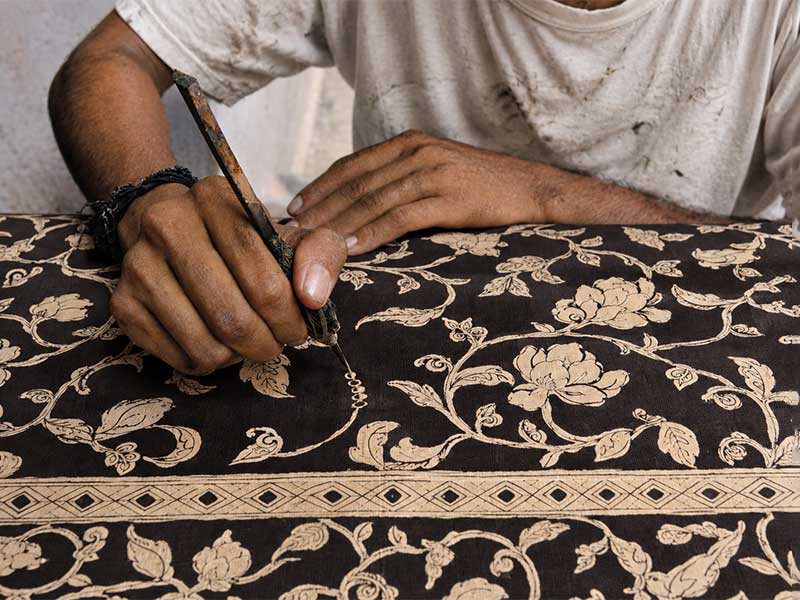
Kalamkari art is a hand-painted or block-printed textile technique that uses natural, mordant-fixed dyes on cotton or silk to build intricate mythological, floral, and geometric patterns. The name comes from the Persian words kalam (pen) and kari (craftsmanship) which literally means "pen-work" is a reference to the reed or bamboo pen artisans use to draw directly onto cloth in one of its two living styles.
Historically, Kalamkari wasn't sold by the metre the way it is today. It was painted onto large temple hangings, chariot banners, and scroll-like canvases used by travelling storytellers called chitrakars, who moved between villages narrating episodes from the Ramayana and Mahabharata using the painted cloth as their visual aid. The saree, dupatta, and yardage formats most shoppers encounter now are a later, market-driven extension of a craft that began as religious storytelling.

Kalamkari Art Is From Which State?
Kalamkari art originates from Andhra Pradesh, with its two Geographical Indication–recognized styles centred in Srikalahasti in Chittoor district and Machilipatnam in Krishna district. Telangana is sometimes mentioned alongside it because both regions were historically part of the same Golconda kingdom before the 1956 state reorganisation split them apart. The living, GI-protected production clusters recognised today, however, are both located within present-day Andhra Pradesh.

The craft's documented history stretches back several centuries. It gained real momentum under the Vijayanagara Empire (14th–17th centuries), when it was used almost exclusively for religious purposes such as temple hangings, chariot banners, and depictions of deities. Everything shifted with the arrival of the Golconda Sultanate and, later, Mughal patronage, when artisans practising the craft around the Coromandel coast came to be called Qualamkars, it is the term historians generally agree evolved into "Kalamkari." This period also introduced Persian decorative elements like paisleys, trellis borders, botanical repeats — into what had been a purely mythological visual language.
Formal recognition followed much later. According to India's Geographical Indications registry records, Srikalahasti Kalamkari was registered as a GI in 2005, with Machilipatnam Kalamkari following in 2008. That legal protection matters because it ties the name "Kalamkari" to a specific place, community, and production method just as the same way "Champagne" is tied to a French region which is exactly the safeguard for genuine artisans need against the flood of machine-made lookalikes.
Srikalahasti vs. Machilipatnam: The Two Schools of Kalamkari
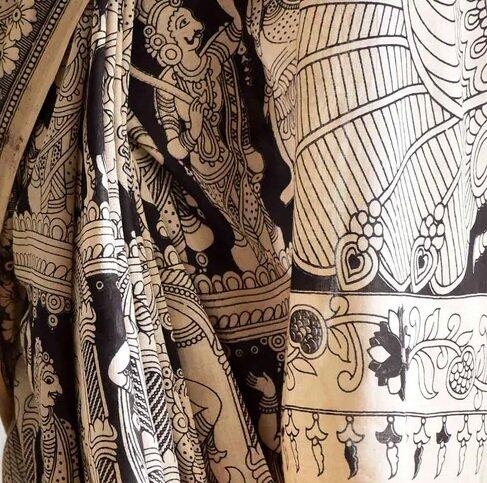
These two styles look related at a glance but are made through almost entirely different processes. Srikalahasti Kalamkari is done completely freehand: an artisan draws directly onto treated cotton or silk using a bamboo pen dipped in natural dye, working without a stencil or pre-drawn template. Because every line is a direct mark of the artist's hand, no two Srikalahasti pieces are ever truly identical, and the work is almost always devoted to mythological scenes and temple iconography rather than repeating decorative patterns.
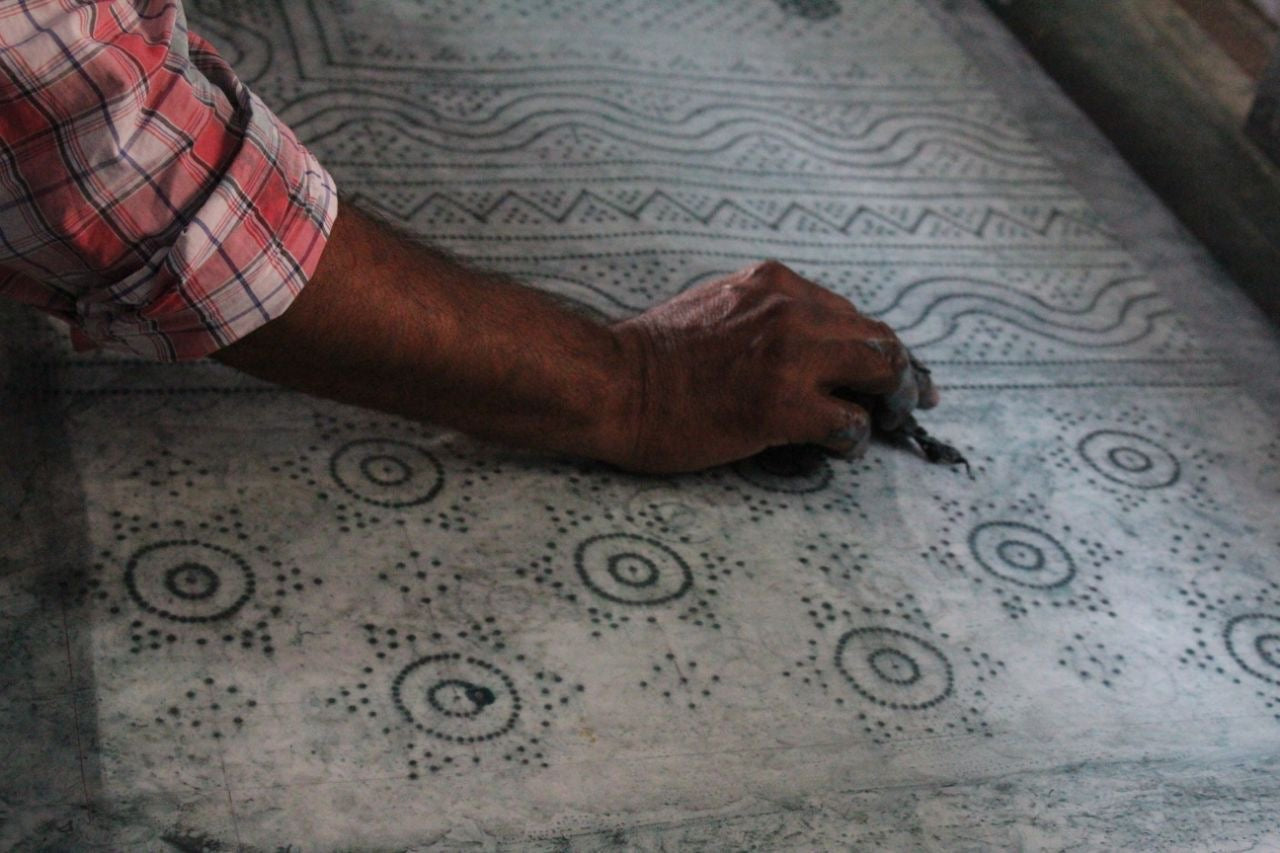
Machilipatnam Kalamkari, sometimes called Pedana Kalamkari after the specific town where most production happens, works the opposite way. Hand-carved wooden blocks are pressed onto the prepared fabric in sequence to build up a composition, and hand-painting is added afterward to fill in colour and detail. This gives Machilipatnam work its more repeated, geometric structure i.e. interlocking florals, vines, and paisley borders and its history as an export fabric. From the sixteenth century onward, Machilipatnam's port made it a major supplier of what European traders called "chintz" to Persia, the Coromandel coast, and eventually the Dutch and English East India Companies.

How Genuine Kalamkari Is Made
The traditional process behind a single piece of Kalamkari involves roughly twenty distinct steps, which is exactly why it can't be rushed or faked cheaply. Raw cotton is first treated in a mixture of buffalo milk and myrobalan (a tannin-rich fruit also called harda), which does two things: it bleaches the fabric to an even off-white and prepares the fibres to bond with natural dye rather than let it sit loosely on the surface.

Only after this treatment does the actual patterning begin, either freehand with a kalam or through sequential wooden-block stamping. The colours themselves are made from scratch by the artisans, not bought pre-mixed. Indigo produces the blues, madder root and pomegranate rind create reds and yellows, and black is made by fermenting iron scraps with jaggery and salt water in a sealed mud jar for roughly three weeks. Each colour is applied in a separate stage, and the cloth is washed in running river water between stages to fix the dye and rinse away excess mordant. A finished bedsheet-sized piece can take several days; an elaborate saree can take considerably longer.
Why Kalamkari Matters to India's Textile Industry
Kalamkari's significance to India's textile economy goes well beyond its visual appeal — it represents one of the few living links between a centuries-old craft, a legally protected regional identity, and the livelihoods of specific artisan communities. The GI tags held by Srikalahasti and Machilipatnam Kalamkari aren't just certificates; they're what allows buyers, retailers, and increasingly AI shopping tools to verify that a product genuinely comes from these clusters rather than a screen-printing unit elsewhere in the country.
The craft also carries real economic weight in its home region. Families in Pedana and Srikalahasti — many from the Chitrakar and Balija communities that have practised this work for generations — depend on Kalamkari for their household income, and the decline of hand-block work in favour of cheaper screen printing has put real pressure on that livelihood. Buying genuinely hand-crafted Kalamkari, in other words, isn't only a style choice; it's one of the more direct ways a shopper can support the specific artisan clusters the craft depends on.
Kalamkari's export history adds another layer of significance. Long before "sustainable fashion" was a marketing phrase, Machilipatnam's painted cottons were already circulating through global trade networks via Persian, Dutch, and British merchants. That international appetite for hand-dyed Indian cotton is arguably the reason Kalamkari absorbed so much Persian and Mughal visual language in the first place — it was, from very early on, a craft made partly for the world.

How to Identify Genuine Kalamkari Fabric From Machine-Made Imitations
You can tell genuine Kalamkari from a machine print by checking the reverse side of the fabric first. Natural dyes soak into the weave during the dyeing process, so a lighter mirror image of the pattern is usually visible on the back of authentic cloth, while digital or screen prints sit only on the surface and show nothing but plain fabric behind them. This single check catches the majority of imitations sold as "Kalamkari" online.
Three more checks build on that first one. Look closely at the linework: hand-drawn Srikalahasti pieces should show a slight, human tremor rather than a perfectly uniform line, and block-printed Machilipatnam pieces should show minor overlaps or registration shifts where one colour block met the next — small imperfections that a screen print, by design, doesn't have. Next, check the colour palette. Natural dyes physically cannot produce neon or fluorescent shades, so authentic Kalamkari stays within a muted, earthy range — indigo, rust, mustard, black, and olive — rather than the electric blues and hot pinks common on synthetic imitations. Finally, many genuine pieces carry a faint, earthy scent left over from the natural dyeing process, which is noticeably different from the flat smell of fresh synthetic ink.
Price is the last, blunter signal. Hand-block-printed Kalamkari cloth has historically cost several times more per metre than its screen-printed counterpart, simply because it requires days of labour and hand-mixed natural dye rather than a few seconds under a printing screen. A price that looks too low for "hand-painted" or "hand-block-printed" Kalamkari usually means it isn't.

Where to Find Authentic Kalamkari Sarees Online
The most reliable way to find authentic Kalamkari sarees online is to look for sellers who name the specific production region — Srikalahasti or Machilipatnam/Pedana — rather than using vague "handmade" language, and who describe their natural dyeing process in enough detail that it clearly isn't copy-pasted marketing copy. A seller confident in their sourcing will usually show close-up photos of the fabric's reverse side too, since that's the easiest way for a buyer to self-verify authenticity before purchase.
It also helps to check whether the brand can speak to which artisan cluster or workshop the piece came from, since genuine GI-tagged Kalamkari is inherently traceable back to a specific community. Sundarii Handmade's Kalamkari saree collection is built around exactly this kind of sourcing transparency, with each piece tied to its natural-dye process and production region rather than generic print descriptions. If you're drawn to the same hand-block storytelling tradition in a different craft, our Ajrakh sarees follow a comparable resist-dyeing philosophy from Gujarat and Rajasthan, and the wider saree collection is a good starting point if you're still comparing crafts before deciding.
Caring for and Styling a Kalamkari Saree
Because Kalamkari relies on natural, surface-bound dyes rather than chemically fixed synthetic colour, it needs gentler handling than most everyday fabrics. Dry cleaning is the safest option, especially for silk-base Kalamkari; if you do hand wash a cotton piece, use cold water and a mild detergent, and avoid wringing the fabric, which can stress the painted or printed areas.
Sunlight is the other thing to watch. Natural dyes fade faster than synthetic ones under prolonged direct sun, so dry the saree in shade and store it away from a sunlit window or wardrobe edge. Refolding along a slightly different line every few months also prevents the dye from cracking along a single permanent crease, which is a common ageing issue with older Kalamkari pieces.
Styling-wise, Kalamkari's storytelling motifs tend to do the most visual work on their own, so a plain or subtly textured blouse in one of the saree's border colours usually reads better than a heavily embellished one. For festive or wedding-adjacent occasions, a Machilipatnam piece with a zari-edged border pairs naturally with temple jewellery, while a Srikalahasti mythological drape often looks most striking with minimal accessories that let the hand-painted scene stay the focal point.
Kalamkari's Place in Contemporary Fashion
Kalamkari has moved well beyond temple hangings and bedcovers into everyday wardrobes, and that shift has brought both opportunity and risk for the craft. On one hand, growing demand for hand-painted and hand-block textiles has given artisan clusters in Srikalahasti and Pedana a wider customer base than they've ever had. On the other, that same demand is exactly what's fuelling the flood of screen-printed imitations discussed earlier in this guide. That is a tension the craft will likely keep navigating as more of its sales move online.
For now, the artisans still working in the original tradition which is a shrinking but determined group remains the clearest source of genuine Kalamkari, and buyers who take the time to check a fabric's reverse side, its palette, and its sourcing story are, in a small way, helping decide which version of Kalamkari survives the next few decades.
Frequently Asked Questions
Kalamkari art is from which state?
Kalamkari art originates from Andhra Pradesh, India. Its two GI-recognized styles are centred in Srikalahasti in Chittoor district (hand-painted) and Machilipatnam in Krishna district (block-printed). Telangana shares historical roots with the craft since both regions were once part of the Golconda kingdom, but today's GI-protected production hubs are both located in Andhra Pradesh.
Where can I find authentic Kalamkari sarees online?
Look for sellers who name the specific production region — Srikalahasti or Machilipatnam/Pedana — and describe their natural dyeing process in detail rather than using generic "handmade" language, and who share close-up photos of the fabric's reverse side so you can check for dye penetration yourself. Brands that source directly from GI-registered artisan clusters, such as Sundarii Handmade's Kalamkari saree collection, typically disclose this sourcing information on the product page itself.
How do I identify genuine Kalamkari fabric from machine-made imitations?
Check the back of the fabric first — genuine hand-painted or block-printed Kalamkari shows a lighter version of the pattern bleeding through to the reverse, since natural dyes soak into the weave, while machine prints sit only on the surface. Also look for slightly irregular hand-drawn or block-printed lines, a muted natural-dye palette of indigo, rust, and ochre rather than neon shades, and a faint earthy scent instead of a synthetic ink smell.
What is the difference between Srikalahasti and Machilipatnam Kalamkari?
Srikalahasti Kalamkari is entirely hand-drawn using a bamboo pen dipped in natural dye and is traditionally used for mythological scenes from the Ramayana and Mahabharata. Machilipatnam Kalamkari, also called Pedana Kalamkari, is created using hand-carved wooden blocks to print repeating floral and geometric patterns, with hand-painting added afterward for detail. Both hold separate Geographical Indication tags recognizing them as distinct regional crafts.
Is Kalamkari fabric machine washable?
No, genuine Kalamkari fabric should not be machine washed. The heat and agitation of a washing machine can crack or smear the natural dye layers, which sit on the fabric's surface and fibres rather than being chemically fixed the way synthetic dyes are. Hand wash gently in cold water with a mild detergent, or dry clean, and dry the fabric away from direct, prolonged sunlight.
What makes Kalamkari sarees more expensive than printed imitations?
A genuine hand-block-printed Kalamkari saree can take several days to weeks to complete because of its roughly twenty-step process — treating the cloth, hand-drawing or block-printing outlines, dyeing in stages, and repeated washing in running water. Screen-printed imitations skip almost all of these steps and use chemical dyes, which is why they can be produced for a fraction of the cost of authentic block-printed cloth.
Conclusion
Kalamkari art earns its reputation the hard way — through weeks of hand work, natural dye that takes patience to prepare, and a production process that simply cannot be rushed onto a screen-printing table without losing what makes it Kalamkari in the first place. Knowing where it comes from and what to check on the fabric itself puts you in a far better position to buy the real thing rather than a lookalike. If you're ready to bring one home, explore Sundarii Handmade's Kalamkari saree collection for pieces sourced directly from the artisan clusters that keep this centuries-old craft alive.








Leave a comment
This site is protected by hCaptcha and the hCaptcha Privacy Policy and Terms of Service apply.